Window of Tolerance: How breathing and meditation help you manage stress
Why you sometimes feel overwhelmed by stress, while at other times you completely shut down and how conscious breathing and meditation can help you develop greater calm and resilience.
Does this sound familiar? Your mind is racing. You find yourself constantly worrying, questioning things, and even the smallest challenges can suddenly feel overwhelming.
Or perhaps you experience the opposite: you feel empty, exhausted, have no energy for anything, and don't quite feel present.
What if these reactions aren't signs that you're unable to cope with stress, but rather signals from your nervous system?
Our bodies have a remarkable system that constantly works to keep us safe. Yet in our busy modern lives, this system is sometimes activated more often than necessary.
The concept of the Window of Tolerance helps us understand why we can respond flexibly to challenges at certain times, while at other moments we feel completely out of balance.
And here's the encouraging part: through conscious breathing, meditation, and small moments of recovery, you can learn to better recognise your body's signals and support your nervous system.
What is the Window of Tolerance?
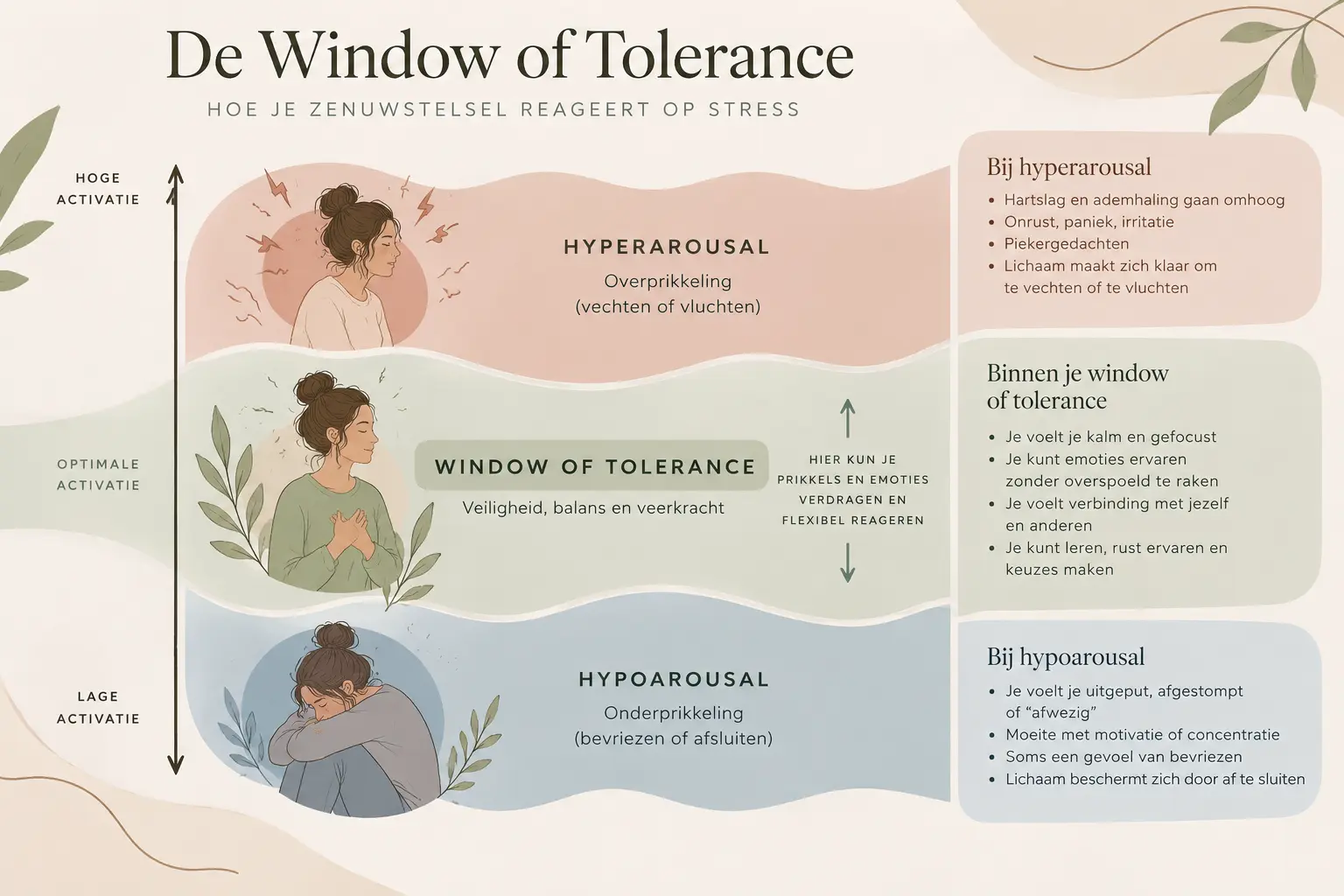
The Window of Tolerance is the range in which your nervous system is sufficiently regulated to process stress, emotions, and sensory input without becoming overwhelmed or shutting down.
The concept was developed by psychiatrist Daniel J. Siegel and is used in fields such as trauma therapy, psychology, and stress management.
When you're within your Window of Tolerance, you can experience emotions without being completely swept away by them. You can think clearly, connect with others, and respond flexibly to challenges
This doesn't mean you always feel calm or happy. You can experience sadness, frustration, tension, or excitement and still remain within your Window of Tolerance.
It's not about being relaxed all the time, but about having enough resilience to navigate life's ups and downs.
When stress becomes too intense or continues for too long, you may move outside this window. Your nervous system then shifts into a different protective response.
What happens in your body when you experience stress?
Stress itself isn't necessarily a bad thing. It's a natural and essential response that helps us deal with challenges and potential threats.
When your brain perceives a situation as threatening or demanding, your body activates several stress-response mechanisms. Your sympathetic nervous system becomes more active, while stress hormones such as adrenaline and cortisol help you become alert and ready for action.
Your heart rate increases, your breathing changes, and your muscles tense up.
This is useful when you need to react quickly, give an important presentation, or deal with a difficult situation.
Problems arise when your stress response remains activated for long periods without enough opportunities for recovery.
Your body then has less time to return to a state of balance.
Within the Window of Tolerance model, we distinguish three main states.
1. Within your Window of Tolerance: safety, connection, and resilience
When you're within your Window of Tolerance, you're generally able to cope with what life throws your way.
You feel sufficiently safe and present to think, feel, and act.
You may recognise this state through the following signs:
- You can concentrate and think clearly.
- You experience emotions without becoming completely overwhelmed by them.
- You feel connected to yourself and others.
- You can handle unexpected situations.
- You have access to creativity, curiosity, and problem-solving skills.
- You can return to a calmer state after a stressful moment.
You don't need to be completely relaxed to be in this state. A healthy amount of tension and energy is part of life.
The goal isn't to eliminate stress from your life, but to learn how to respond to it more flexibly.
2. Hyperarousal: When your nervous system goes into overdrive
During hyperarousal, your level of activation rises above your Window of Tolerance. Your body enters a heightened state of alertness.
This is often associated with the fight-or-flight response.
You might recognise this when your schedule is packed, you're constantly available to others, or you feel as though you're always trying to catch up.
Possible signs include:
- Rapid or shallow breathing
- Heart palpitations or tense muscles
- Overthinking and a mind that won't switch off
- Irritability, impatience, or emotional outbursts
- Restlessness and difficulty relaxing
- Increased sensitivity to noise, crowds, or other stimuli
- Difficulty falling asleep
Your body is preparing you for action, even when there is no immediate physical danger.
In this state, it can be difficult to think rationally or make conscious decisions. You're more likely to react through automatic patterns of behaviour.
3. Hypoarousal: When your system shuts down
Not everyone responds to stress with restlessness or panic.
Sometimes, the exact opposite happens.
When stress becomes overwhelming, your system may shift into a state of reduced activation. Within the Window of Tolerance model, this is called hypoarousal.
This state is often described as withdrawing, freezing, or shutting down.
Possible signs include:
- Feeling empty, numb, or emotionally disconnected
- Having little energy or motivation
- Feeling disconnected from yourself or your surroundings
- Difficulty making decisions
- Feeling heavy, sluggish, or exhausted
- Feeling as though you're functioning on autopilot
Hypoarousal isn't the same as ordinary tiredness or relaxation. It can be a protective response when your system feels unable to cope with a situation.
It's important to remember that these symptoms can also have other causes. Persistent or severe symptoms deserve professional attention.
Why is your Window of Tolerance sometimes smaller?
Your Window of Tolerance isn't a fixed boundary.
The amount of stress you can handle at any given moment changes depending on several factors.
These include sleep, prolonged work pressure, physical health, nutrition, social support, past experiences, and the amount of recovery time you allow yourself.
After a good night's sleep, a relaxing weekend, or a refreshing walk, you may find that you can handle much more than after a week filled with deadlines, poor sleep, and emotional tension.
Past difficult experiences or trauma can also influence how quickly your nervous system detects danger and how strongly it responds.
Your resilience isn't simply a matter of mindset or willpower. Your physical state plays an important role too.
The good news? You can learn to recognise when you're approaching the limits of your Window of Tolerance and discover which habits help you regain a greater sense of balance.
This is where breathing and meditation come in.
How can breathing help regulate your nervous system?
Breathing is remarkable because it happens largely automatically, yet you can also consciously influence it. You can speed up your breathing, slow it down, or briefly hold your breath. This makes breathing an accessible way to influence processes involved in stress regulation.
When you experience stress, your breathing pattern often changes automatically. You may start breathing faster, more shallowly, or more irregularly.
But this relationship also works in the opposite direction.
By consciously slowing your breathing and keeping it comfortable, you can influence processes involved in stress regulation.
Calm breathing can help slow your heart rate, bring your attention back to your body, and reduce feelings of tension.
In particular, a slow, steady breathing rhythm and a gentle, unforced exhalation can have a calming effect for many people.
It's important to understand that there isn't one breathing technique that works for everyone in every situation.
When you're feeling highly overstimulated, gentle, slower breathing may be helpful. When you're feeling numb or disconnected, it may be more beneficial to begin with gentle movement, reconnecting with your surroundings, or another mildly activating activity.
Breath regulation doesn't mean you always need to control your breathing. It means learning to recognise what your body needs in that moment.
A practical breathing exercise for stress: lengthen your exhale
Do you notice your mind racing, your shoulders tightening, or your breathing becoming shallow?
Try this simple exercise.
- Sit comfortably and feel your feet resting on the ground.
- Breathe in gently through your nose for approximately 4 counts.
- Exhale softly for approximately 6 counts, without forcing the breath.
- Repeat for 1 to 3 minutes.
- Afterwards, allow your breathing to return to its natural rhythm.
The exact count isn't important. Choose a pace that feels comfortable and relaxed.
If you experience dizziness, shortness of breath, or increased tension, stop the exercise and return to your normal breathing.
The goal isn't to breathe perfectly, but to give your body an opportunity to settle.
How can meditation help you stay within your Window of Tolerance?
While breathing can help influence physical tension, meditation can support you in recognising your thoughts, emotions, and bodily sensations.
During meditation, you practise being present with your experience without immediately reacting to it.
You might notice how quickly your mind wanders. Or perhaps you become aware that your jaw is clenched, your shoulders are raised, or your breathing speeds up as soon as you think about work.
By noticing these signals earlier, you create space to respond differently.
Regular mindfulness meditation may help reduce perceived stress and support emotional regulation. The effects vary from person to person and depend on the type of practice and individual circumstances.
Meditation doesn't automatically make stressful situations easier. However, it can help you become more aware of how you respond to them.
A simple bodyscan meditation
Breathing and meditation: Why the combination can be so valuable
Breathing and meditation naturally complement each other.
Conscious breathing provides a way to influence physical tension. Meditation helps you become more aware of your inner experiences and respond less automatically.
Together, they can support you in developing three important skills:
1. Awareness
You learn to recognise when tension is building, when you're becoming overstimulated, or when you're starting to shut down.
2. Self-Regulation
You discover which techniques help you regain a greater sense of balance.
3. Resilience
You develop habits that help you navigate stressful moments more effectively and create space for recovery.
This doesn't mean you'll never move outside your Window of Tolerance again.
Even people who meditate or practise breathing exercises every day experience stress, sadness, anger, and overwhelm.
The difference lies in learning to recognise these moments and finding ways to respond to them.
5 ways to support your Window of Tolerance in everyday life
You don't need to completely change your life to become more mindful of how you deal with stress. Often, meaningful change begins with small, manageable habits.
1. Check in with yourself regularly
Ask yourself a few times throughout the day: How does my body feel? Am I feeling restless, present, or somewhat disconnected? Simply recognising your current state is already a valuable first step.
2. Take conscious breathing breaks
A few minutes of calm breathing between appointments or after a busy working day can help reduce accumulated tension.
3. Spend time outdoors and move your body
Walking in nature, getting daylight, and engaging in gentle movement can support recovery and well-being. You don't always need to sit still to find calm.
4. Build small moments of meditation into your day
Start with just a few minutes each day. Consistency is often more achievable than an occasional long meditation session.
5. Respect your need for recovery
Adequate sleep, moments of rest, social connection, and healthy boundaries are important foundations for stress regulation.
And perhaps most importantly: try not to turn relaxation into yet another task on your to-do list.
You don't always have to be productive, even when you're working on your well-being.
Can you expand your Window of Tolerance?
You can develop your ability to cope with stress and emotions. With sufficient recovery, supportive relationships, and regular practice of regulation skills, certain situations may become easier to manage over time.
Breathing exercises and meditation can play a role in this process.
However, it's important to approach this with nuance. There is no simple way to objectively measure the size of your Window of Tolerance, and research has not demonstrated that any specific breathing exercise literally expands your tolerance window by a measurable amount.
The model is primarily a valuable tool for understanding your experiences.
In cases of persistent nervous system dysregulation or trauma, support from a qualified healthcare professional may be necessary. Intensive breathing techniques or prolonged meditation are not suitable for everyone at every moment.
It's not about learning to tolerate more and more stress, but also about recognising when you've reached your limits.
Frequently asked questions about the Window of Tolerance
What does the Window of Tolerance mean?
The Window of Tolerance describes the state in which your nervous system is sufficiently regulated to process stress and emotions without becoming overwhelmed or shutting down.
What is the difference between hyperarousal and hypoarousal?
Hyperarousal involves increased activation, such as restlessness, tension, overthinking, or a rapid heartbeat. Hypoarousal involves reduced activation, such as numbness, emotional disconnection, withdrawal, or low energy.
Can breathing help with stress and overstimulation?
Yes. Calm, comfortable breathing can help reduce physical tension and perceived stress. A slow, unforced breathing rhythm can be particularly supportive. However, the most suitable technique varies from person to person.
Can meditation calm your nervous system?
Meditation, including mindfulness, can help reduce stress and support emotional regulation. Not every type of meditation feels calming for everyone. During periods of significant dysregulation, shorter practices that focus on awareness of your surroundings may be more appropriate.
How do you know if you're outside your Window of Tolerance?
You may notice signs such as intense restlessness, overthinking, panic, or irritability, but also emotional numbness, withdrawal, or a sense of shutting down. The model can help you recognise these experiences, but it is not a diagnostic tool.
Finding more calm starts with listening to your body
We live in a world that constantly encourages us to move faster, do more, and always be available.
But our nervous system doesn't only need challenges and stimulation. It also needs safety, connection, and recovery.
Understanding your Window of Tolerance is a first step towards becoming more aware of how you respond to stress.
Breathing and meditation can support you along the way. Not as miracle solutions, but as practical skills that help you reconnect with yourself.
Because resilience doesn't mean you always have to be strong or that you never lose your balance.
It means learning to recognise what's happening within you, understanding what you need, and finding ways to create space for balance again and again.
Would you like to discover what conscious breathing can do for you?
During a breath coaching session, we explore how your breathing is connected to tension, stress, and recovery. You'll learn to listen more closely to your body and discover gentle, practical breathing techniques that you can also use at home.
Give yourself a moment to slow down, catch your breath, and reconnect with yourself.
Discover my breath coaching sessions and book an introductory call.